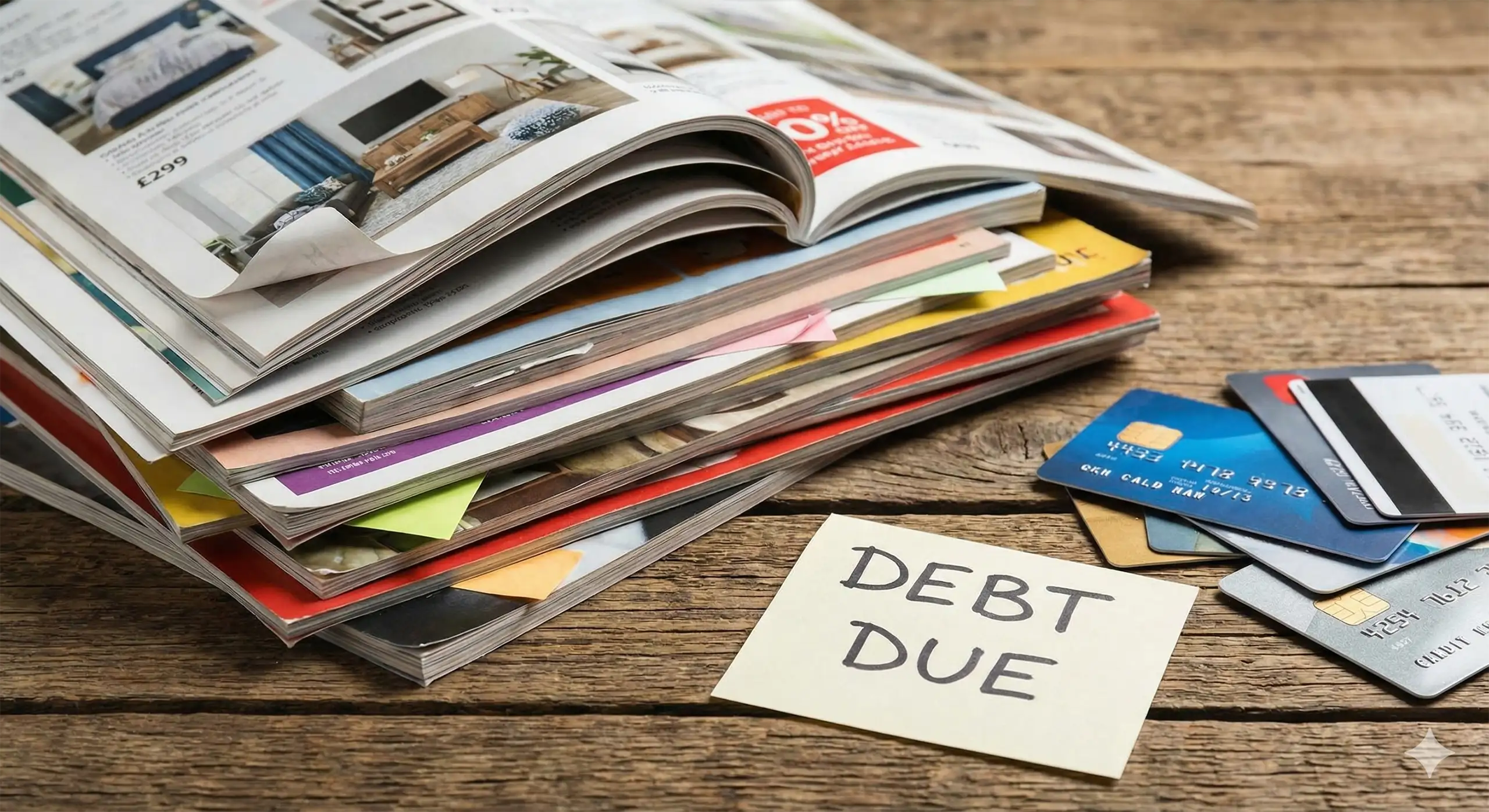
A disorderly stack of open shopping catalogues resting on a wooden table, accompanied by scattered credit cards and a yellow sticky note reading 'DEBT DUE'.

Help With Catalogue Debt

Catalogue debt affects thousands of people across the UK, and whilst it might feel manageable at first, the interest charges and payment demands can quickly add up.

At NDH Financial, we’re personal insolvency specialists with our own licensed Insolvency Practitioner in-house. We help people understand their options when dealing with catalogue debt and find lasting solutions that provide legal protection from creditor pressure.

Many people dealing with catalogue debt discover that an Individual Voluntary Arrangement (IVA) offers complete legal protection, stopping all creditor contact whilst you repay what you can afford over 5-6 years. Any remaining qualifying debt is then written off**.

What is Catalogue Debt?

Catalogue debt is money you owe to mail-order or online shopping catalogues. These companies allow you to order goods and spread the cost through weekly or monthly payments, often with the option to pay in instalments or defer payment over time.

Catalogue debt is classified as unsecured debt, meaning it’s not secured against any of your assets or property. This means catalogue debt is classed as a non-priority debt – the catalogue company can’t repossess the items you’ve bought if you fall behind on payments, but they can take other actions to recover what you owe.

Types of Catalogue Debt

Buy Now, Pay Later Catalogues

These accounts let you order items and defer payment for a set period – typically 3, 6, or 12 months. If you pay the full balance within this period, you usually won’t be charged interest. However, if you don’t clear the balance by the deadline, interest is applied retrospectively from the date of your catalogue purchase, often at very high rates.

Traditional Credit Catalogues

Standard catalogue accounts work like revolving credit. You’re given a credit limit, you order what you need, and you make regular payments towards the balance. Interest is charged on the outstanding amount, and you can continue ordering more items as long as you stay within your credit limit.

Store Cards

Many catalogue companies offer store cards that work like credit cards but can only be used with that particular retailer. These often come with high interest rates (sometimes over 30% APR) making balances grow quickly if you only make minimum payments.

Interest-Free Credit

These arrangements charge no interest if you clear the balance within the agreed timeframe, but missing the deadline usually results in backdated interest charges.

Get in touch today

NDH Financial can help free you from the shackles of your debt.

Call us on 0800 002 9051 or apply below.

If you’re an existing client, please call us on 0800 002 9061.

Individual Voluntary Arrangement (IVA)

Causes of Catalogue Debt

Catalogue debt can build up for various reasons, often starting innocently before spiralling beyond control.

Easy Access to Credit

Catalogues are designed to make shopping simple. With quick online applications and instant credit decisions, you can start ordering within minutes. This convenience makes it easy to spend without fully considering whether you can afford the repayments, especially when the catalogue company keeps increasing your credit limit.

High Interest Rates

Many catalogue accounts charge interest rates between 30% and 40% APR, significantly higher than most credit cards. When you only make the minimum payments, the majority goes towards interest rather than reducing the actual balance you actually owe. A £500 purchase can end up costing hundreds more if you don’t clear it quickly.

Multiple Catalogue Accounts

It’s common for people to have several catalogue accounts at once. You might start with one, then open another when that reaches its limit, and before long, you’re juggling payments across multiple companies. Each account has its own payment schedule, interest rate, and terms, making it difficult to keep track of what you owe.

Changes in Circumstances

Losing your job, reduced working hours, illness, relationship breakdown, or unexpected expenses can all mean that catalogue payments suddenly become unaffordable. What started as a convenient way to spread costs becomes another financial pressure you can’t pay.

Buy Now, Pay Later Traps

The appeal of ‘nothing to pay for 12 months’ can be deceptive. These offers encourage spending without immediate financial impact, but when the payment deadline arrives, many people haven’t set aside the money. The interest charges then make the debt significantly larger than the original purchase price.

Using Catalogues When Money Is Tight

Some people turn to catalogues when they can’t afford essential items like school uniforms, winter coats, or household appliances. The ease of ordering from home can also become a way to cope with stress or difficult emotions. Whilst this provides immediate relief, it creates a debt that needs repaying – often with high interest charges – which can be difficult when money is already stretched.

Will catalogue debt affect my credit score?

Yes, catalogue debt appears on your credit file and can impact your credit score.

Making regular payments on time can actually improve your score by demonstrating responsible credit use. However, missing payments or falling behind will damage your credit rating.

Catalogue debt problems that harm your credit score include:

  • Late or missed payments
  • Defaults (registered after six months of non-payment)
  • County Court Judgments if the company takes legal action
  • High credit utilisation (using most of your available limit)

Most negative information remains on your credit file for six years from the date of the missed payment or default, even if you’ve cleared the debt. This can affect your ability to get mortgages, loans, or other credit during this period.

What happens if I can't pay my catalogue debt?

If you fall behind on catalogue payments, the company will typically follow these stages:

Reminder letters and calls – The catalogue company contacts you asking you to catch up on missed payments

Default notice – A formal warning giving you at least 14 days to pay the arrears before further action

Default registered – After six months of non-payment, a default appears on your credit file

Debt collection agency – Your account may be passed to a debt collection agency or sold to a debt purchaser

County Court Judgment – The company may apply to court for a CCJ ordering you to pay

Bailiff action – If you don’t keep to a CCJ payment order, bailiffs may be instructed (though they cannot force entry for catalogue debt)

You should engage with the catalogue company early. Ignoring letters and calls makes the situation worse, but honest communication about your circumstances can lead to manageable payment plan arrangements.

Can you write off catalogue debt?

Yes, it’s possible to pay off catalogue debt through formal debt solutions. However, it won’t simply disappear on its own – you’ll need to take action.

If you haven’t made a payment or acknowledged the debt in writing for six years, it may become statute-barred. This means the catalogue company can no longer take you to court to recover it, though the debt itself doesn’t legally disappear, and they can still contact you about it.

Individual Voluntary Arrangement (IVA)

An IVA is a legally binding agreement between you and your creditors that allows you to consolidate your debts into one monthly payment and repay what you can afford over 5-6 years. Once approved:

  • All catalogue companies must stop contacting you
  • Interest and charges are frozen
  • You make one affordable monthly payment based on your circumstances
  • Any remaining catalogue debt is written off after completion**

You may qualify for an IVA if you owe £7,000 or more in unsecured debt (including catalogue debt), have regular income, and can afford monthly payments.

Check if You Qualify for an IVA

Debt Relief Order (DRO)

A DRO is suitable if you have less than £50,000 in total debt, a few assets worth less than £2,000, and little spare income after essential costs. Your catalogue debt is frozen for 12 months, and if your situation doesn’t improve, the debt is written off at the end of this period.

DROs are now free to apply for in England and Wales, making them accessible for people with limited resources.

Learn More

Debt Management Plan (DMP)

A DMP is an informal arrangement where you make reduced monthly payments to your creditors. Whilst this can provide breathing space, it offers no legal protection – catalogue companies can still contact you and add interest. DMPs work best for short-term financial difficulties.

Learn More

Bankruptcy

Bankruptcy writes off catalogue debt, usually within 12 months. However, it’s a serious step with significant consequences – your assets may be sold, and it affects your credit rating for six years. Bankruptcy should only be considered when other options aren’t suitable.

Learn More

Breathing Space

The Breathing Space scheme gives you 60 days of protection from creditor contact whilst you seek debt advice. During this time, catalogue companies must stop chasing payment and can’t add interest or charges. This gives you time to explore longer-term solutions like an IVA.

Learn More

Tips for Dealing with Catalogue Debt

Taking control of catalogue debt starts with practical steps you can take right now.

Stop Using the Catalogues

Cut up catalogue cards if you have them, delete saved payment details from websites, and unsubscribe from promotional emails. You can’t reduce your debt whilst continuing to add to it.

Work Out What You Owe

List all your catalogue debts including the company name, account number, current balance, interest rate, and minimum monthly payment. This gives you a clear picture of your total catalogue debt and helps you prioritise which debts to tackle first.

Check Your Statements Carefully

Catalogue companies sometimes add fees for late payments, returned payments, or account maintenance. Review your catalogue statements for any errors or charges you don’t recognise and challenge it immediately in writing.

Contact the Catalogue Companies

Contact each company, explain your situation honestly, and ask about a reduced repayment plan. A lot of catalogue companies will freeze interest or accept lower monthly payments if you’re experiencing genuine financial hardship.

Prioritise Essential Spending

Make sure you’re covering essential costs first like rent or mortgage, council tax, utilities, and food. Catalogue debt is unsecured and non-priority, so it comes after these essential payments. Don’t sacrifice essentials to keep up with catalogue payments.

Get Professional Debt Advice

If you’re struggling to manage your catalogue debts, speaking to a debt adviser can help you understand your options. Professional advice is confidential, non-judgmental, and can help you find the right solution for your circumstances.

Struggling with catalogue debt? Contact NDH Financial Today

If catalogue debt is causing you stress, and you’re unsure how to move forward, NDH Financial can help. We’re personal insolvency specialists with our own licensed Insolvency Practitioner in-house, and we’ve helped thousands of people regain control of their finances.

Our debt consultants will review your situation honestly and help you understand whether an IVA, or another debt solution, is right for your circumstances. We’ll explain everything clearly, with no pressure and no obligation to proceed.

Don’t let catalogue debt control your life. Contact us today for a confidential consultation.

Have More Questions? Our IVA Learning Hub Can Help

We know you might have questions and that's fine. We can answer most of those on our call.

But we've also built our learning hub so that you can learn more about an IVA and see if one is right for you.

Click below to check it out.